The short answer
MAGI-2 Preview was a research release published on August 5, 2026 to show that its architecture, training system and data pipeline could scale together at the 100B level. MAGI-2, released on November 24, 2026, is the full release: more than 4× larger (about 480B parameters instead of about 114B), trained on about 3× more data (about 4T tokens), followed by targeted post-training and 1080p upscaling. Its 4-task average Elo on Artificial Analysis Video Arena v2.1 rose from 998.5 to 1150.3.
If you are a creator, MAGI-2 is the model you will use. If you are a researcher, MAGI-2 Preview remains the most detailed public description of how the architecture works.
MAGI-2 vs MAGI-2 Preview at a glance
| MAGI-2 Preview | MAGI-2 | |
|---|---|---|
| Release | August 5, 2026 | November 24, 2026 |
| Purpose | Intermediate research release | Flagship model |
| Total parameters | ~114B | ~480B |
| Active parameters per token | ~6B | ~28B |
| Backbone | Single-stream Transformer + Multi-Head Latent MoE | Same design, scaled more than 4× |
| Pre-training data | Baseline | ~4T tokens, about 3× Preview |
| Video Arena Elo (AA v2.1, 4-task avg.) | 998.5 | 1150.3 (+151.8) |
| Output for creators | Not positioned as a creative product | Up to 30 s · 1080p · 25 fps · native audio |
| References | — | Up to 20 (10 images, 5 videos, 5 audio) |
| Editing and timeline control | — | Shot-cut control and targeted video editing |
| Open weights | Research release with a public GitHub repository | Announced, not yet released |
Sources: the MAGI-2 Preview research post and the MAGI-2 release notes.
What MAGI-2 Preview established
A simpler starting point than MAGI-1
The earlier MAGI-1 model generated video autoregressively in temporal chunks, which enabled streaming and continuation. For MAGI-2 Preview the team chose a simpler path: a single-stream Transformer in which text, video and audio share one token sequence, inherited from the daVinci-MagiHuman work. Avoiding chunked generation kept the number of moving parts manageable while scaling to 100B parameters.
The Preview configuration
The Preview post is unusually specific about its layout:
| Component | MAGI-2 Preview |
|---|---|
| Backbone | 40 Transformer layers |
| Sparse layers | Middle 36 layers use Multi-Head MoE; 4 boundary layers stay dense |
| Model width | 3,072 |
| Routed representation | 12 heads × 256 dimensions |
| Expert pool | 256 experts per head |
| Active experts | Top-6 per head (72 expert units per token per layer) |
| Expert FFN | 256 → 1,280 → 256, fused SwiGLU |
The team calls this Ultra-Fine-Grained MoE: instead of a few wide experts, each sparse layer holds 3,072 narrow, head-local expert units that can be recombined independently.
Systems that made 100B practical
The Preview introduced Hierarchical Head Parallel (fixed head ownership across nodes, sharded expert states within a node), MagiMoE (a fused routing-to-merge execution path for small experts) and MagiMuon (an optimizer that orthogonalizes head × expert matrices separately). It also described the data filtering trap: when training data is trimmed to what a small model can learn, the data becomes the ceiling for a larger one.
What changed in MAGI-2
Scale: 114B → 480B
MAGI-2 keeps the Preview backbone and scales it more than 4×, from about 114B total (6B active) to about 480B total (28B active). The team says sticking with Multi-Head Latent MoE was driven by hardware and systems scalability as much as by modeling gains. In controlled ablations, an 8-head Multi-Head Latent MoE reached lower validation loss than a standard MoE and slightly outperformed a single-head LatentMoE, with roughly a 22% training speedup at 480B.
Data: about 4T tokens
Pre-training data grew about 3× to roughly 4T tokens across about 1 billion samples, annotated in three weeks. Complex footage — multi-character scenes, fast cuts, on-screen text, dense sound — was kept rather than filtered.
Post-training and upscaling
The Preview was a research checkpoint. MAGI-2 adds reinforcement learning for lighting, texture and material detail, and a latent spatiotemporal upscaler that outputs 1080p at 25 fps while re-injecting reference images to keep faces and text sharp.
Product capabilities
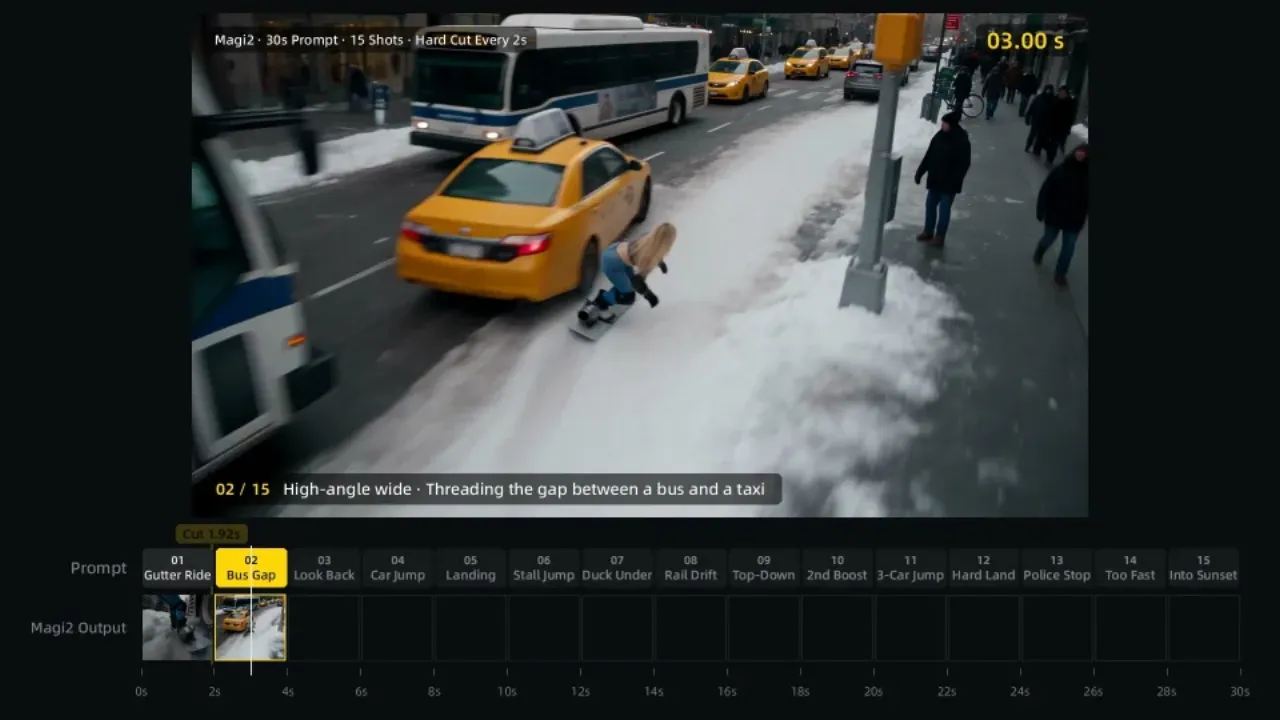
MAGI-2 is the first version described as a full creative tool: up to 30 seconds per generation, native audio with lip-sync, six aspect ratios, omni-reference with up to 20 files, timeline and shot-cut control, and editing of existing footage.
Emergence — and its cost
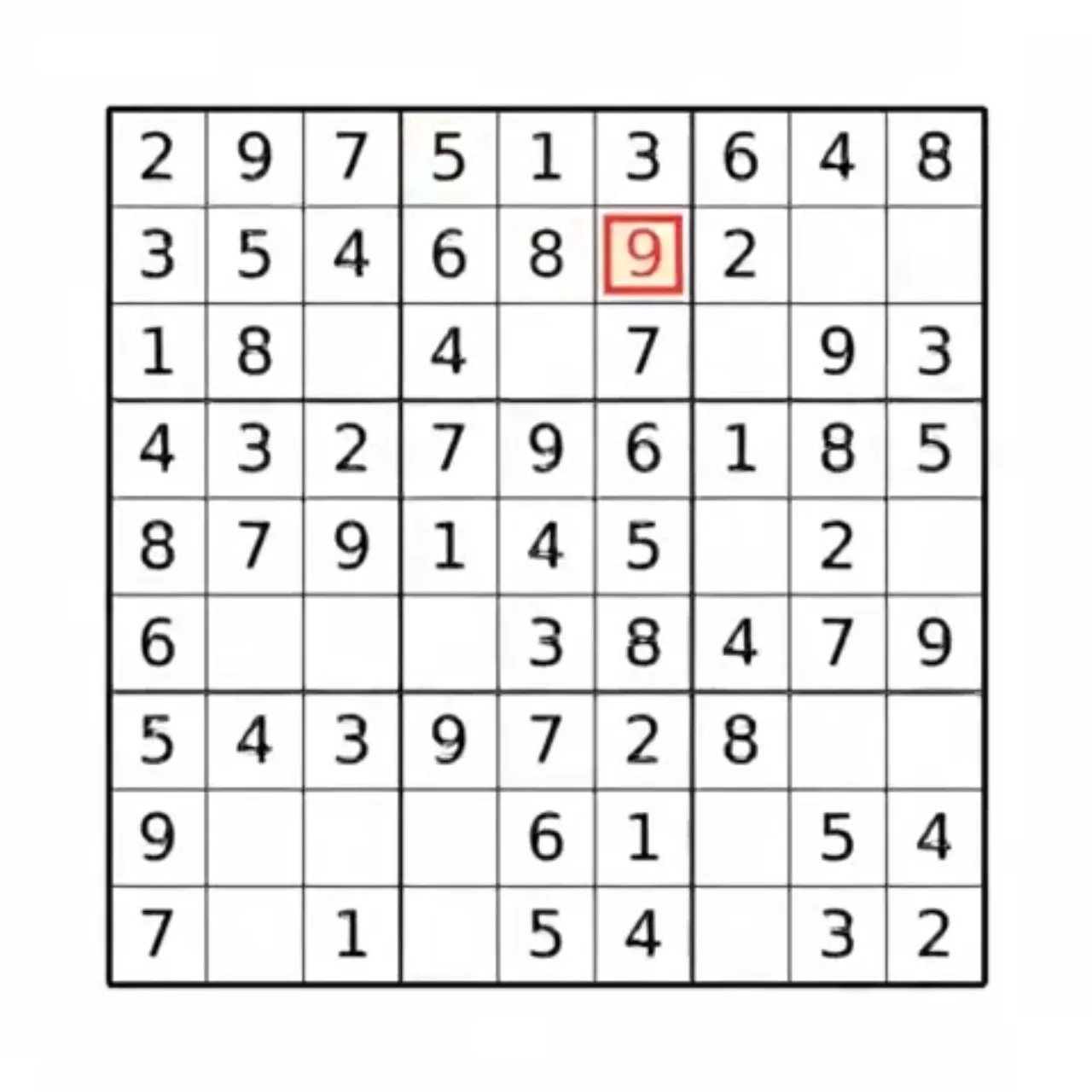
Testing the 480B pre-trained checkpoint turned up early visual reasoning (Sudoku, mazes), autonomous shot planning and cross-lingual dialogue. These became harder to elicit after aesthetic post-training, a trade-off the team is now studying. The Preview made no such claims.
Which one matters to you?
| You are… | Look at |
|---|---|
| A creator making ads, short dramas or social video | MAGI-2 — it is the version with 30-second audio-video output and references |
| A researcher studying video MoE | MAGI-2 Preview’s architecture post and GitHub repository, then MAGI-2’s technical report when it is published |
| Planning to self-host | Wait for the announced MAGI-2 open-weight release |
Can I use MAGI-2 or MAGI-2 Preview on magi-2.si?
You can use MAGI-2: it sits at the top of the model menu in our video studio, renders 1080p with native sound and costs 25 credits per second. MAGI-2 Preview was a research release rather than a creative product, so it is not offered. Watch the MAGI-2 release examples or read what MAGI-2 is first.
FAQ
Is MAGI-2 Preview the same as MAGI-2?
No. MAGI-2 Preview (about 114B parameters) is the August 2026 research release; MAGI-2 (about 480B) is the November 2026 flagship built on the same architecture.
Is MAGI-2 Preview open source?
MAGI-2 Preview came out as a research release with a public MAGI-2-preview repository on GitHub. Check that repository for the current license and what it includes.
Why did the Elo score rise so much?
The release notes credit the +151.8 Elo gain to scaling model capacity, systems and data together, plus targeted post-training and 1080p upscaling.
Will there be a MAGI-3?
None has been announced. The stated next steps are open-sourcing MAGI-2, publishing a technical report and improving data, efficiency and post-training.

 Model guides