MAGI-2 open source in one paragraph
MAGI-2 is not open source yet. Open weights and a detailed technical report were announced with the model’s release on November 24, 2026, but as of November 26, 2026 neither has been published. The earlier models in the same family took a more open route: MAGI-1 came out with open weights, and MAGI-2 Preview shipped as a research release with a public repository. So there is a real track record here — just no MAGI-2 download yet.
This page explains what was announced, how the MAGI models got here, what open weights would actually change for creators and developers, and what you can do in the meantime. We will update it as soon as anything is released.
What has been announced
Here is the short version of what the MAGI-2 release notes and launch coverage say about openness:
- Open weights are planned. The team says it intends to release the MAGI-2 weights “as soon as possible”, subject to compliance requirements.
- A technical report is coming. It is expected to cover the full architecture, the training system and evaluations in more detail than the release notes.
- Hardware support is broadening. Launch coverage reports that MAGI-2 has already been adapted to Chinese accelerators from Hygon and Moore Threads, not only NVIDIA GPUs.
- No date yet. There is no public release date, license or model card for the MAGI-2 weights at the time of writing.
Until a license is published, nobody outside the team can say exactly what commercial use, fine-tuning or redistribution will be allowed. Treat any “MAGI-2 download” you find today with suspicion.
The MAGI family, step by step
MAGI-2 did not appear from nowhere. Each step in the family solved a different problem:
| Model | When | What it introduced | Openness |
|---|---|---|---|
| MAGI-1 | 2025 | Autoregressive video generation: video built chunk by chunk, good for streaming and continuing a clip | Open weights |
| daVinci-MagiHuman | 2026 | A single-stream Transformer that generates video and audio together from one token sequence | Research paper |
| MAGI-2 Preview | August 5, 2026 | ~114B parameters (~6B active) with Multi-Head Latent MoE, proving the design scales past 100B | Research release, public repository |
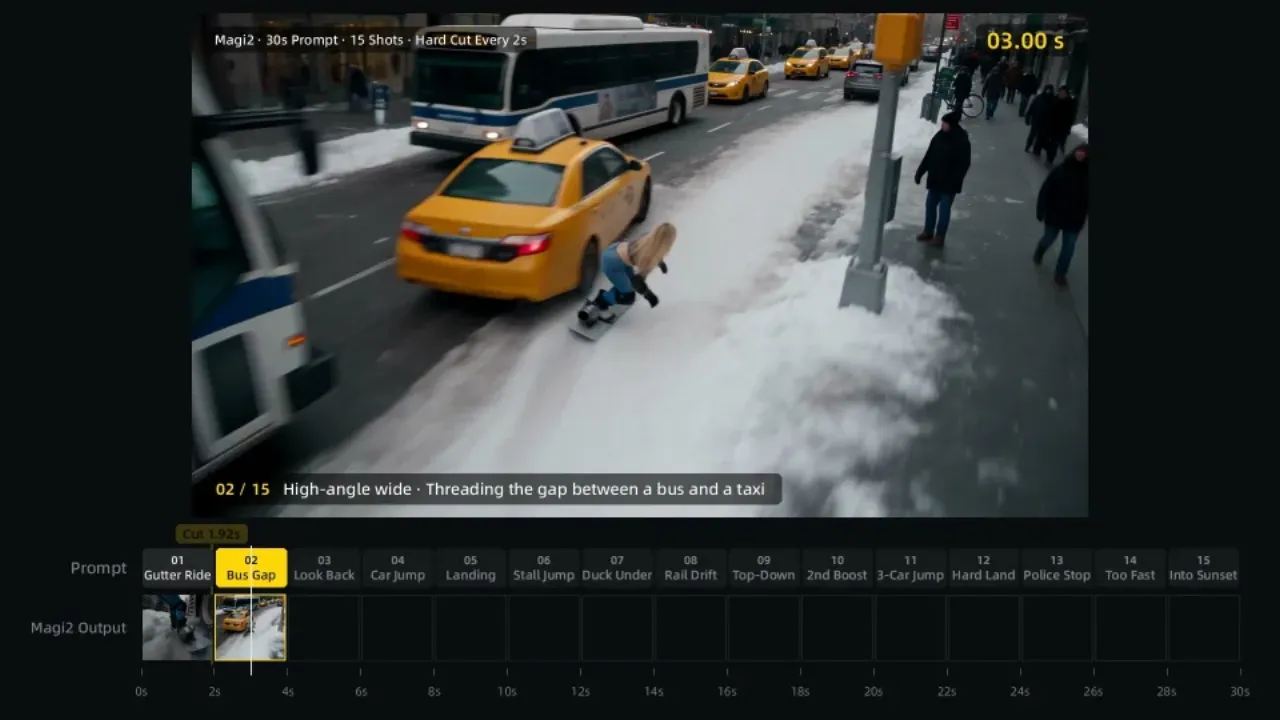
| MAGI-2 | November 24, 2026 | ~480B parameters (~28B active), ~4T training tokens, 30-second 1080p video with native sound, 20 references, timeline cuts and editing | Open weights announced, not yet released |
The big shift between MAGI-1 and MAGI-2 is the move away from chunk-by-chunk generation. MAGI-2 treats text, video and audio as one stream, which is why it can plan a whole 30-second scene — picture and sound together — in a single generation. You can read the details in What is MAGI-2? and MAGI-2 vs MAGI-2 Preview.
What “open weights” would mean for you
“Open source” gets used loosely for AI models. For MAGI-2, the realistic expectation is open weights: the trained model files you can download and run yourself, plus code to load them. That is different from a fully open project with training data and every training script.
If the weights arrive with a permissive license, it would mean:
- No per-second fees once you own the hardware — your cost becomes electricity and depreciation.
- Private generation. Scripts, faces and product shots never leave your machines, which matters for agencies and brands.
- Fine-tuning. Studios could adapt MAGI-2 to a house style, a recurring character or a specific product line.
- A community toolchain. Quantized versions, faster schedulers and editing tools usually follow open releases within weeks.
The catch is the license. Some “open” video models forbid commercial use or cap the size of companies that may use them. Read it before you build a business on it.
There is also a bigger picture. Image generation changed fast once strong open models appeared: prices dropped, niche tools multiplied and small teams could compete with big ones. Launch coverage of MAGI-2 makes the same argument for video. Short-drama studios and ad teams often generate a clip three to five times before they get a usable take, so the price per second decides how many ideas they can afford to test. An open model at this quality level would push that cost down again and let more people experiment.
Can you run MAGI-2 locally?
Probably not on a normal computer — at least not at first. MAGI-2 has about 480 billion parameters. Thanks to its Mixture-of-Experts design only about 28 billion are active for each token, which keeps the compute per step down, but all of the experts still have to live in memory somewhere.
- Memory. At 16-bit precision, 480B parameters need on the order of a terabyte of GPU memory, spread across a multi-GPU server. Quantized versions could cut that a lot, but expect quality trade-offs.
- Time. A 30-second 1080p clip with sound is a lot of tokens. Even on strong hardware, expect minutes per clip rather than seconds.
- Engineering. Multi-node inference, sharding the experts and the separate 1080p upscaler all need setup and maintenance.
A practical middle ground is likely to appear quickly: cloud GPU providers and hosted platforms tend to offer new open models within days of release, so you can pay per clip without managing servers. For most creators, a hosted service will stay the practical option even after the weights are out. Open weights matter most to studios with their own GPUs, researchers and companies with strict privacy rules.
What to do while you wait
- Learn the prompt style now. MAGI-2 reads prompts like a shot list. Our MAGI-2 prompt guide shows how to write scenes as timed beats.
- Study real examples. Watch the MAGI-2 examples to see what long takes, references and native audio look and sound like.
- Use MAGI-2 on magi-2.si today. You don’t need the weights to create: MAGI-2 runs in our studio for text to video, image to video and media to video, so you can build prompts and references now and keep them for local runs later.
- Follow the updates. We track releases on the updates page.
MAGI-2 open source FAQ
Is MAGI-2 open source?
Not yet. Open weights and a technical report have been announced, but nothing had been published as of November 26, 2026.
When will the MAGI-2 weights be released?
No date has been announced. The team has only said it will release them as soon as possible, subject to compliance requirements.
Was MAGI-1 open source?
Yes. MAGI-1 was released with open weights, and MAGI-2 Preview came out as a research release with a public repository.
Can I run MAGI-2 on my own GPU?
Not today, because the weights are not available. Even after release, the full 480B model will need a multi-GPU server; smaller quantized versions may make it easier later.
Will open weights allow commercial use?
That depends on the license, which has not been published. Check it before using MAGI-2 output or weights commercially.
Can I download MAGI-2 now?
No legitimate MAGI-2 weight download exists yet. Be careful with files that claim to be MAGI-2.

 Model guides